Cycle II: Shaping independent and confident thinkers
A comprehensive bilingual program for 4th, 5th, and 6th grade, where critical thinking, in-depth research, and academic autonomy prepare students for the challenges of middle school and empower them to navigate the world with confidence.

From Student to Independent Learner
Bilingual Program (Spanish–English)
Schedule: 8:00 AM - 3:00 PM
Learning with Purpose. Growing with Confidence.
In 4th, 5th, and 6th grade, students enter a transformative stage of academic and personal development. Cycle II guides them as they grow from guided learners into confident, independent thinkers, ready to take ownership of their learning.
Through meaningful, hands-on projects and authentic experiences, students strengthen critical thinking, research skills, and clear communication. They learn to question, analyze, and express ideas with purpose—becoming active participants in their educational journey.
Every learning experience is designed to connect knowledge to real life, encourage problem-solving, and prepare students with confidence for the challenges of secondary school and beyond.
Education with Purpose, Balance, and Vision
In Cycle II, students experience a key stage of academic consolidation and personal growth. They learn in an active and reflective way, deepening their understanding of the world around them while developing critical thinking, autonomy, and responsibility. Each learning experience is intentionally designed to strengthen both academic and emotional development, supporting students as they transition toward higher levels of independence. Our approach fosters intellectual curiosity, mindful participation, and meaningful learning, laying strong foundations for informed decision-making and the holistic growth of each student.
Aligned with the MEP and Strengthened by International Standards
Our program follows the guidelines of Costa Rica’s Ministry of Public Education (MEP) and is enriched with international standards and programs that broaden students’ academic perspective and prepare them to confidently engage in an increasingly globalized world.
Going Beyond In addition to meeting MEP requirements, we incorporate proven international methodologies that deepen learning and ensure each student moves forward with confidence, autonomy, and critical thinking—well prepared for the challenges of secondary school and the demands of today’s world.
English as a Tool for Learning and Communication
At this stage, English is consolidated as an advanced academic and communication tool. Students use it naturally to analyze, research, debate, and express increasingly complex ideas, as well as to learn academic content across different subject areas.
This approach builds strong academic bilingualism, where language becomes a means to think, create, investigate, and construct knowledge within a truly bilingual, dynamic, and challenging environment.
Areas of Development in Cycle II
These are the areas that will transform your child into a competent, curious, and confident student:
English in 4th, 5th, and 6th Grade: Academic Communication, Advanced Fluency, and Language Mastery
In Cycle II, the English course focuses on functional and academic mastery of the language. Students develop authentic, fluent, and confident communication, using English as a tool to learn, analyze, research, and express complex ideas.
Conocer más
Our native English-speaking teachers provide precise linguistic models of pronunciation, intonation, and structure, strengthening increasingly natural, expressive, and comprehensive reading.
The program integrates the four core language skills:
- Fluent and deep reading, with excellent pronunciation, appropriate rhythm, and literal, inferential, and critical comprehension.
- Assertive oral communication, fluent, confident, and with mastery of academic vocabulary for argumentation, explanation, and participation in discussions.
- Coherent and structured writing, with continuous vocabulary expansion and conscious use of grammatical structures appropriate for the level.
- Active and analytical listening, understanding different accents, identifying key ideas, interpreting communicative intent, and responding accurately.
As a key component of reading development, students use the Oxford Reading Buddy platform daily, allowing them to listen to expert models, practice recorded reading for self-correction, expand vocabulary, reinforce grammar, and develop the reading habit through motivating and challenging texts.
This comprehensive approach ensures that students not only learn English, but master it as a high-level academic tool, using it with purpose, confidence, and precision.
Spanish in Cycle II: Sophisticated Communication and Complex Thinking
In Cycle II, Spanish is a fundamental tool for deep reasoning, precise expression, and critical thinking. Students learn to use language intentionally, analyze it reflectively, and master it as a medium to interpret reality and communicate complex ideas.
Conocer más
The program develops competent readers, conscious writers, and confident communicators through:
- Critical reading of literary, informational, persuasive, and technical texts.
- Deep literary analysis, exploring themes, symbolism, structures, narrative techniques, and historical contexts.
- Purposeful writing, producing narrative, expository, and argumentative texts with clarity, coherence, and audience awareness.
- Advanced grammar, applied to ensure precision and style.
- Formal speaking and debate, with evidence-based argumentation.
- Academic research, using reliable sources, proper citations, and ethical criteria.
Access to a broad library collection strengthens the reading habit, expands vocabulary, and fosters a deep and personal relationship with reading, ensuring Spanish mastery that goes beyond academics and accompanies students throughout their lives.
Mathematics in Cycle II: Logical Thinking, Abstract Reasoning, and Intellectual Autonomy
In Cycle II, mathematics progresses from concrete to abstract. Students develop logical thinking, algebraic reasoning, and problem-solving skills, laying a solid foundation for secondary-level mathematics.
Conocer más
The program respects individual learning rhythms, promotes multiple strategies, and encourages flexible concept representation. Students work on:
- Advanced operations with integers, fractions, decimals, and percentages
- Algebraic thinking and simple equations
- Applied geometry and spatial analysis
- Measurement, unit conversion, and proportional reasoning
- Statistics and probability in real-life contexts
- Multi-step problem solving
The i-Maths platform supports personalized learning, allowing students to deepen understanding and progress with autonomy and confidence.
Science in Cycle II: Scientific Thinking and Experimental Learning
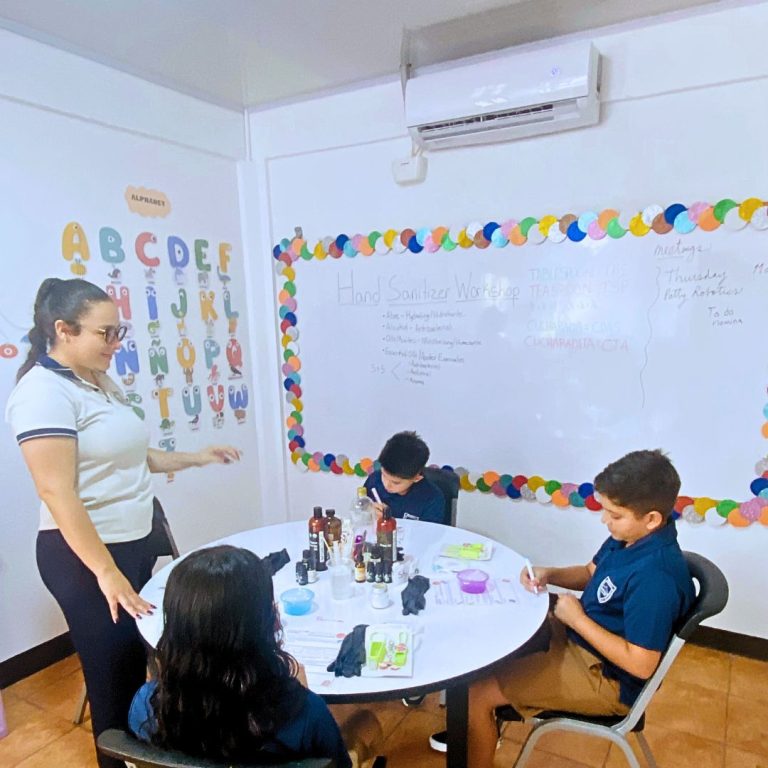
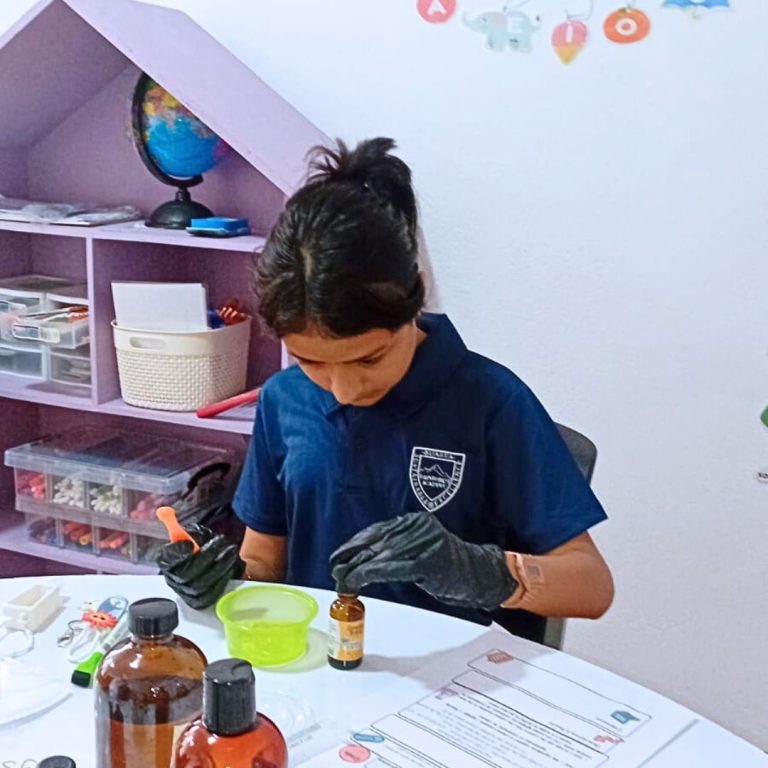
In Cycle II, Science is primarily developed in the laboratory, where students learn to think and act like scientists. Through hands-on experiences, guided experiments, and small investigations, they systematically apply the scientific method to understand natural phenomena.
Conocer más
Students explore the main branches of natural sciences—biology, chemistry, physics, geology, and astronomy—formulating hypotheses, designing procedures, collecting and analyzing data, and communicating evidence-based conclusions.
This rigorous, experimental approach fosters scientific curiosity, logical reasoning, and critical thinking, helping students develop a deep understanding of natural processes and prepare academically for secondary-level science challenges.
Social Studies and the World in Cycle II: Deep Historical, Geographical, and Cultural Analysis
In Cycle II, the Social Studies program builds on the official MEP curriculum and is enriched with Oxford Express resources, offering students a rigorous, internationally-oriented education.
Conocer más
The program fosters a comprehensive understanding of history, geography, and human societies, both locally and globally. Students study countries, regions, and continents, identifying geographical location, physical characteristics, climate, resources, population, and territorial organization, and understanding how these factors influence daily life.
As a key component of academic excellence, the program strengthens general knowledge, enabling students to understand:
- Country and regional locations worldwide
- Customs, traditions, and lifestyles of different cultures
- Forms of social, political, and economic organization
- Similarities and differences among societies
- The relationship between geography and human development
Students analyze historical processes, causes, and consequences, identifying patterns of change and continuity, and connecting past and present to understand contemporary global challenges. This integrated approach develops critical thinking, global awareness, and intercultural understanding, preparing students to navigate a connected world with confidence, respect, and discernment.
Sustainability in Cycle II: Science, Community, and Planetary Responsibility
Sustainability is a core institutional pillar and a central project in Cycle II at BRFA. Living and learning in Bijagua, within a biological corridor, inspires students to be conscious, informed, and responsible toward their natural and social environment.
Conocer más
Students explore local ecosystems, analyze human-nature interactions, identify real community needs, and develop systemic thinking and environmental awareness.
BRFA is certified in the international GLOBE program, supported by NASA, allowing students to participate in real scientific research, collect environmental data, and contribute to global studies. This connects classroom learning to applied science and international research networks.
Through authentic projects, responsible practices, and concrete actions, students cultivate the commitment to care for, protect, and regenerate their environment, becoming agents of change prepared to face present and future environmental challenges.
GLOBE Program: Global Science from Our Community
At BRFA, Cycle II students actively participate in the GLOBE Program (Global Learning and Observations to Benefit the Environment), an international scientific initiative backed by NASA.
Conocer más
Students collect and analyze real environmental data, monitor local ecosystems, and contribute to global studies on climate, water, biodiversity, and other natural systems.
Through this project, students learn to:
- Observe and record scientific information accurately
- Analyze results in relation to global phenomena
- Collaborate with scientists and schools worldwide
- Apply sustainability knowledge and community action
The GLOBE Program reinforces BRFA’s educational vision: forming students who are curious, responsible, and committed to science, their community, and the planet, becoming conscious agents of change ready for the challenges of the future.
Library in Cycle II: Academic Research and Critical Thinking
The library evolves into a center for research, analysis, and intellectual growth. Students develop advanced reading comprehension and essential research skills, learning to evaluate sources, compare information, and cite ethically.
Conocer más
They work with increasingly complex literary, historical, scientific, and informational texts, fostering analytical reading, reflection, and evidence-based argumentation. This practice strengthens critical thinking and prepares students for rigorous academic work in secondary school.
Technology Lab in Cycle II: Computational Thinking and Creative Problem-Solving
The Technology Lab is an academic space where students think, create, research, and solve problems using technology. They develop logical, computational, and creative thinking through structured projects, programming exercises, and digital tool applications.
Conocer más
Students:
- Begin programming and computational thinking using sequences, logic, patterns, and basic algorithms
- Design interactive projects and communicate ideas digitally
- Analyze cause-and-effect relationships and solve technological challenges
This approach promotes critical, responsible, and creative use of technology, strengthening autonomy and digital literacy.
Visual Arts in Cycle II: Art History, Techniques, and Critical Expression
Visual Arts is approached as an intellectual, historical, and expressive discipline. Students study art critically, analyzing works from different periods, cultures, and movements while understanding their historical, social, and cultural context.
Conocer más
They practice advanced artistic techniques, develop long-term projects integrating research and planning, and use various visual media to express complex ideas, emotions, and worldviews. The program cultivates creativity, aesthetic sensitivity, and critical analysis.
Music in Cycle II: History, Theory, Technique, and Performance
Music is taught as a comprehensive academic discipline, combining history, theory, technique, and performance. Students study styles and composers from diverse eras and cultures, understanding music in its historical and social context.
Conocer más
They develop vocal and instrumental skills, analyze musical works, and engage in creation and composition. Music is experienced individually and collaboratively, strengthening listening, discipline, and teamwork, while integrating analytical thinking with artistic expression.
Physical Education in Cycle II: Strategy, Health, and Character Development
Physical Education goes beyond movement, focusing on holistic development. Students engage in physical and sports activities with strategic planning, understanding rules, tactics, and training processes.
Conocer más
The program promotes advanced motor skills, health awareness, fitness, discipline, perseverance, leadership, and cooperation, fostering healthy habits and lifelong well-being.
Integral Support Department in Cycle II: Academic and Socio-Emotional Guidance
The Integral Support Department provides personalized, continuous guidance during this key stage of transition to secondary school. Students receive support for academic, emotional, and social development, with timely interventions for individual needs.
Conocer más
Study strategies, organizational skills, and enrichment programs are provided, particularly for those seeking advanced academic challenges in sixth grade.
This close support ensures that each student progresses with confidence, balance, autonomy, and readiness for the next educational stage.
Schedule Options That Adapt to Your Family’s Needs
We understand that every family is different. That’s why we offer flexible options for both parents and students.
Monday to Friday
Regular schedule 8:00 AM - 3:00 PM
Ideal for families with afternoon availability or part-time work schedules.
Includes:
- Full academic program
- Snack times
- All developmental areas
- Access to the library and learning resources
- Science and Technology Lab
- Arts, Music, and Physical Education
Extended Schedule
Monday to Friday - Cost ₡500 per hour
7.00 AM - 8.00 AM | 3:00 PM - 4:00 PM
We offer an extended care program for families who need additional hours, guaranteeing quality attention and a safe environment after the regular school day. Includes:
- Safe supervision
- Rest/quiet time
- Recreational activities
- Afternoon snack time
Extracurricular Workshops: Explore Beyond the Classroom
Opportunities to deepen interests and develop new skills.
Contemporary Dance
Folkloric Dance
Body Expression
Chess
Arts & Crafts
Robotics
Taekwondo
Cooking
Music
Sports
Theater
Drawing
Schedule
Monday through Friday | 3:15 PM - 4:15 PM
Hese workshops are NOT mandatory, but they’re a fantastic way for your child to explore different activities.
Important note: Extracurriculars have an additional cost and require prior registration.
You can enroll your child in one, several, or all of them.
II Ciclo - 2026
Lista de útiles escolares
This list covers all three grades of Cycle I. These are materials your child will use regularly.
Personal Supplies
- 1 pencil case 2 No.
- 2 graphite pencils box
- 1 white eraser
- 1 pencil sharpener with a receptacle
- 1 30 cm ruler
- 1 pair of round-tipped scissors
- 1 box of colored pencils (12 count)
- 1 box of markers (12 count)
- 1 glue stick 1 highlighter
- 1 whiteboard marker
- 3 bottles of 250ml tempera paint (primary colors of your choice)
- 5 paintbrushes
Stationery and Paper
- 1 ream of white letter-sized bond paper
- 1 package of assorted construction paper
- 5 sheets of cardstock (aprox.100cm x 70cm of assorted colors)
- 4 ruled notebooks, 75 pages each (labeled: Spanish, English, Science, World History) 1
- grid-lined notebook, 100 pages (labeled: Math)
- 1 letter-sized drawing notebook
- 1 plastic envelope-style folder with dividers for Spanish subjects
- 1 plastic envelope-style folder with dividers for English subjects
Hygiene and personal care
- Science Lab Apron: Contact Sidney at 71006026
- 1 toothbrush & toothpaste
- 1 Mosquito Repellent 1 Sunscreen
- 1 Pack of Hand Wipes
- 1 lunch box
- 1 reusable water bottle
- 1 small backpack.
Otros
- 1 lunch box
- 1 reusable water bottle
- Rain boots and raincoat
- 1 small backpack
*(los cuadernos se envían a casa los viernes)

Frequently Asked Questions
What all II Cycle parents ask
Does my child need to know English before enrolling?
No. Students are placed in beginner, intermediate, or advanced groups based on an initial MAP Growth assessment. Our program adapts to each child’s level for steady, effective progress.
What if my child is ahead or needs extra support?
Instruction is differentiated daily. We offer enrichment for advanced learners and targeted support through our Student Support Department when needed.
How flexible is the extended schedule?
Very flexible. You pay only for the hours you use (₡500/hour). No long-term commitment is required—use it occasionally or daily as needed.
What if my child cries at drop-off?
This is normal. Our team supports children through separation, and most settle in quickly. We keep families informed if needed.
Are extracurricular activities mandatory?
No. Extracurriculars are optional. You may choose one, several, or none.
What documents are needed for enrollment?
Passport or ID, vaccination records, and—if available—the most recent report card. We’ll guide you through the process.
What should I send in my child’s lunchbox?
Healthy, easy-to-eat foods in appropriate portions. Families receive a healthy lunchbox guide upon enrollment.
Does the school offer cafeteria service?
Yes. Snacks and lunches are available. Menus are created and supervised by a specialized nutritionist and can be managed through Cloud Campus.
Can we visit the school before enrolling?
Absolutely. We welcome visits and trial classes—just let us know.
We begin the school year for 2026.
Let’s embark together on a path to a bright future
Join Us for Enrollment at Bijagua Rainforest Academy